

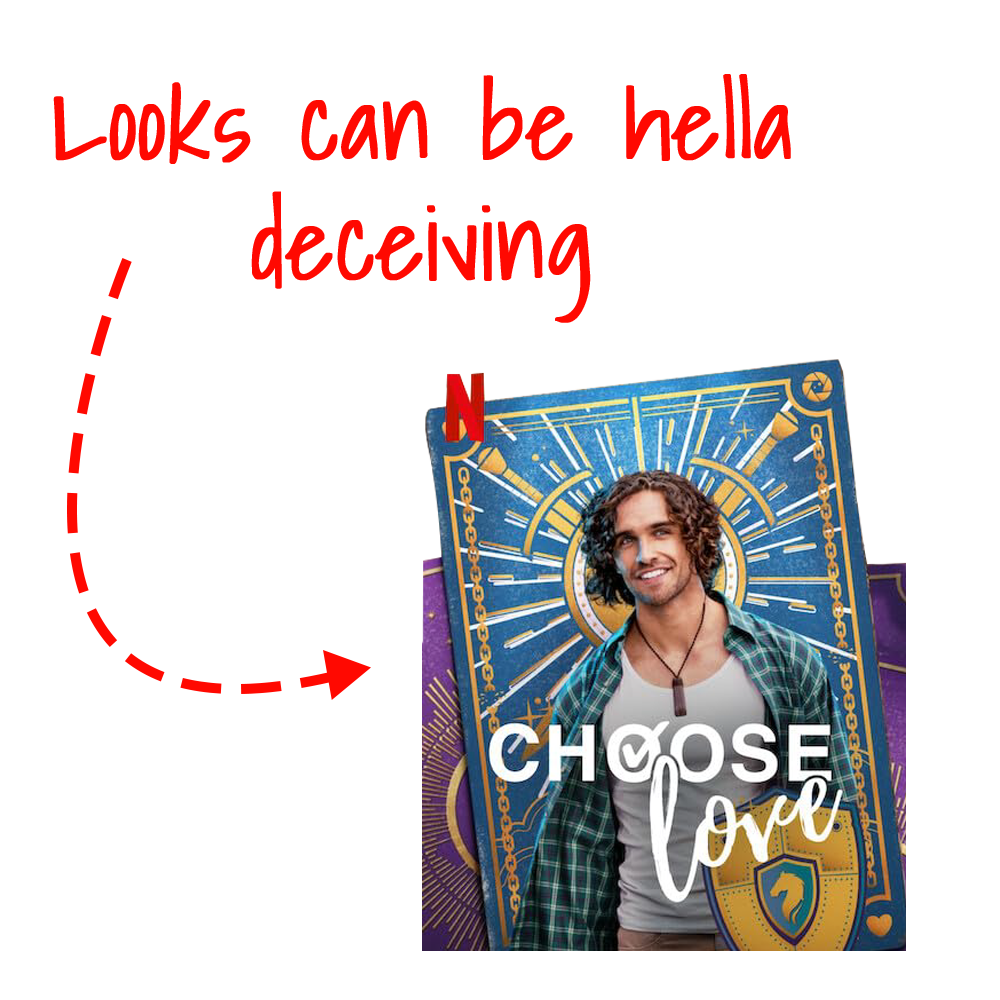
Netflix has always made imaginative strides into visual storytelling with its insistence on inclusivity, choose-your-own adventure style interactive shows/ movies, showcasing genres otherwise considered indie, to name a few. It’s most recent foray into the interactive movie scene – a romcom cleverly named Choose Love – left a lot to be desired on all accounts. One step forward and several backward.
Not even taking the actual story into consideration which has been dissected by several blogs before, there was a single phenomenon that stuck out like a sore thumb for me. The New York Times and The Guardian have already chewed it up and spit it out, if you want to read those reviews. Allow me to give you a little background before diving into the side troubled waters I discovered in the show, if you haven’t had a chance to experience this style of visual media before.
Thinking in tropes
Choose Love begins with the protagonist, perky and high-strung Cami Conway, at a forced crossroads in her life. There’s no reason besides “I wonder what could happen” that drives her to visit a tarot card reader because apparently she’s bored by how perfect her world is — stable, loving relationship of three years with a wonderful guy and interesting job that she’s actually very good at. The story then branches out into three distinct romantic cliches which the user has nominal control over. The nice guy who loves you (Paul), the one that got away (Jack Menna), and the rockstar dreamboat (Rex Galier).
Cami often breaks the fourth wall and talks directly to the viewer, asking them to make a choice. This is very different from Netflix’s immensely popular Black Mirror: Bandersnatch (2019) in which the main character has no clue that his actions are being controlled by the viewer and when he does slowly figure it out, completely loses his mind. Or another one of Netflix’s shows, Jurassic World Camp Cretaceous: Hidden Adventure (2022), where this question of ‘who’s in control’ is totally ignored. But unlike those shows, the choices you make in Choose Love have little to no significance on the storylines that have been chosen for you. It’s a parade of predictable moments that fail to titillate because you can see how it all ends from a mile away. Unlike its predecessors which had elements of suspense (will I get eaten by dinosaurs or murder my own father), this superficial romantic plot follows a privileged white woman creating her own problems and expecting us to care. There are six possible endings to the movie. Spoiler alert but unless you want to spend roughly two hours of your life on the show, I would suggest you read on. Two where you end up with Paul the nice guy, one apiece for the sudden romantic injections Rex the rockstar and Jack the high school sweetheart, and two where Cami ends up alone.
Which brings me to my gripe with the movie.
Choose misery
With the explosion of social media and the seemingly endless reservoir of choice we have today, many young people inadvertently end up choosing to make themselves miserable. Weirdly, for the first time, it feels like Netflix is promoting that through this movie. Why would a successful, attractive, and bright woman actively choose to leave a committed relationship of three years just because of happenstance? Thinking from the other side of this situation, what did Paul ever do wrong? He was sweet, supportive, and graceful in the face of his long-term girlfriend’s hesitation in marrying him. The movie does try to give a reason for Cami’s reluctance in her parents getting divorced and remarried which makes her question each step. However, if three years of stability cannot convince a girl that who she’s with is in it for the long haul, I don’t know what can. This is supplemented with two of the endings as well where Cami ends up with either Rex or Jack. How can one trust a person’s commitment if all it takes for it to shatter is the possibility of something better coming along?
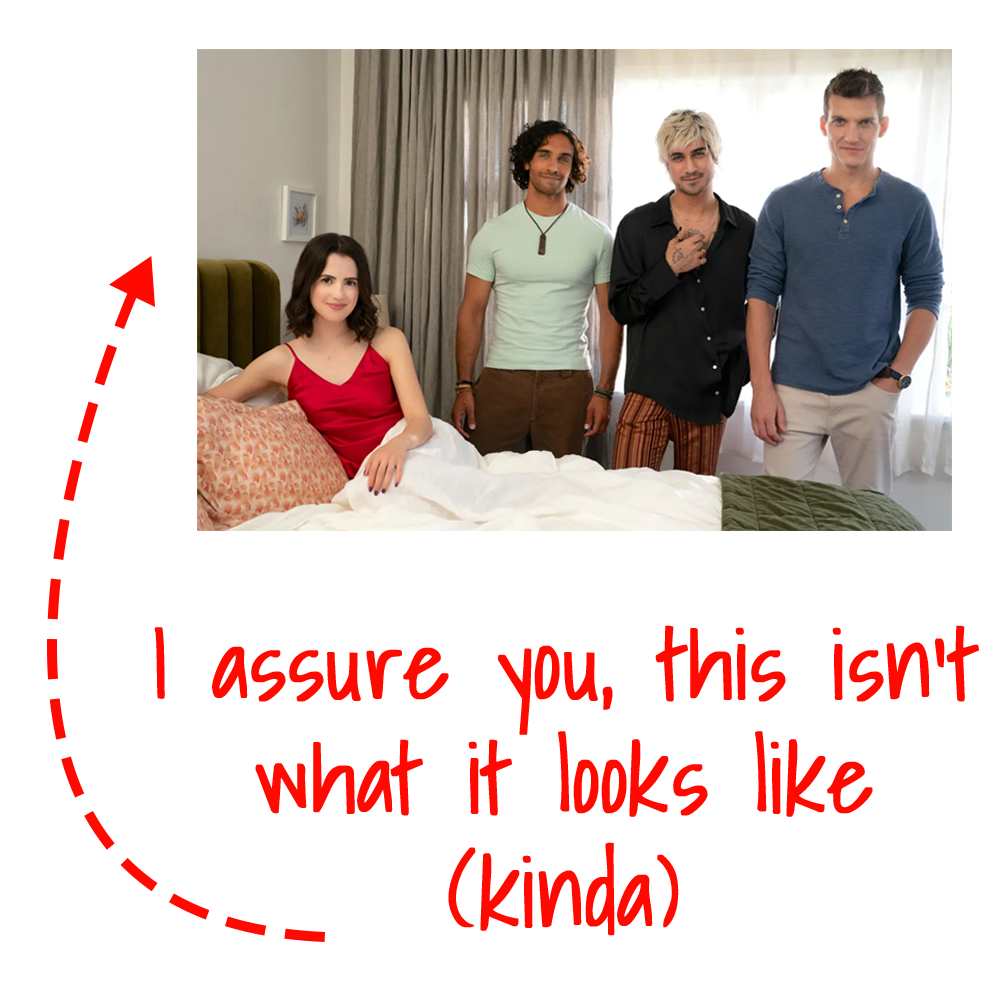
Is this what I’m supposed to do in my life? Always searching for the grass that is supposedly greener on the other side? Or keep praying at the shrine of my past for ‘the one that got away’, hoping that they’d return. Netflix would certainly want me to think that way. Even if I selected the choices as far away as possible from Jack the old flame, Cami still pined about him. When he showed up in a pivotal moment at a protest outside the hotel Cami was supposed to perform with Rex, I almost flung my phone across the room. Please stop forcing Jack and the romantic baggage which apparently I’m supposed to carry on me. And this is not even considering poor Paul.
When I first began watching Choose Love, I was choosing for Cami. The fact that she was questioning her decision to be with Paul the minute alternatives appeared in her life immediately alerted me to the fact that she didn’t want to be with him on a subconscious level. That’s why I discarded him in favor of exploring my options. A part of me felt bad for Paul and I tried to get a clean break whenever the choice presented itself. But Cami kept stringing him along and the movie kept shoving Jack in my face. I don’t want to be beholden to the past. Call me old school but when a relationship is over, one should treat it as finality with utmost respect to the decision. Not use it as a machete to threaten your current partner whenever there is conflict.
“I believe it is highly unfair to the one you’re currently with if you have one foot in the present and the other playing hopscotch in the past or the future.”
Gauravaaditya Kulkarni, author of Near Touch
Promoting a culture that disrespects commitment in favor of choices is dangerous. There will always be someone better, more popular, richer, and better looking than you. Would you want the person you’re with to leave you in favor of these characteristics despite years of love, affection, and care? If that’s the case, then divorces, separations, and anxiety are going to be consequences of the sacrifice loyalty will make. There’s a small caveat though. If the reasons are genuine like two people growing apart, domestic abuse, mental health issues, for example, then I do believe that separation is in favor of one’s health and happiness. But if you are leaving a person who has been by your side with nothing but patience, loyalty, and understanding because you might find someone better down the line, there is something amiss.
Not love, actually
Companionship and loyalty are two pillars of love that support the structure from the back and as a result are often overlooked. It is unrealistic to expect that you will never get bored with a person. Though sacrificing years of love in hopes of a maybe is a gamble that only works out in fiction, rarely in reality. I hope in chasing waterfalls you don’t end up drowning. Maybe if Paul had been presented as a distinct third choice that Cami didn’t know before, the playing field could be declared even. But in its current state, the story is a selfish tale of a woman who rejected the person who had been nothing but kind to her for three years in favor of either wild, surfer curls or a hot British accent.
I’m curious though. Who did you pick out of our three leading men — Paul, Jack, or Rex? Or did you end up alone like my unfortunate friend who was so indignant, he went back to his previous choice to end up with the heartthrob with a charming smile. Struggling to breathe laughing, I reminded him that there are no do-overs in real life. Comment down below, I would love to know! Maybe I’ll tell you who I ended up with (wink-wink).
The future is now, old man
I also officially predict that this type of “unique” and “interactive” storytelling is going to grip our multimedia widely in the near future. Everyone wants a unique experience. I got many adorable scenes with Rex that I wouldn’t have otherwise gotten to see had I chose differently. If a completionist tries to get all the endings, it could very well end up becoming a movie lasting half a dozen hours at least. I’m sure a person fond of Easter eggs could spend a significant chunk of time analyzing and decoding each branch of the story, trying to uncover something unique through a vast possibility of outcomes. xLetalis is still creating content off of the Witcher 3: Wild Hunt with hidden messages and storylines that the average player might never see and that game came out in 2007. Maybe a more nuanced romance story will outshine Choose Love which was a solid effort in itself.
Check out this cool article by NPR’s Linda Holmes who wrote about the movie from the current hot topic of AI producing content faster than any person could and potentially snuff out human creativity in storytelling. It is another angle to view this exciting stage that may result in a pop culture dystopia or a global renaissance.
Resources
- Choose Love (2023) on IMDb for pictures and other media. Retrieved September 3, 2023.
- Shaffer, Claire (August 31, 2023). “‘Choose Love’ Review: Pick Your Own Cliché”. The New York Times. ISSN 0362-4331. Retrieved September 4, 2023.
- Horton, Adrian (August 31, 2023). “Choose Love review – interactive Netflix romcom is a gimmick too far”. The Guardian. ISSN 0261-3077. Retrieved September 4, 2023.
- Silva, Gabriela (August 31, 2023). “Choose Love endings explained: How many are there?”. Dexerto. Retrieved September 5, 2023.
- Holmes, Linda (September 02, 2023) This romcom lets you pick the ending — that doesn’t make it good.
- Watch Choose Love (2023) officially on Netflix. The thing that started it all. Retrieved September 5, 2023.
 Gauravaaditya