

One of the first major assignments of Master’s in Journalism and Communication, I was faced with a choice between three excellent Indian movies sublimely based on politics to review – the journalistic drama Rann (2010), the biographical drama The Accidental Prime Minister (2019), and the satirical Pipli Live (2010). It was an interesting exercise in analyzing a different field altogether from the lens of popular media.
The sphere of politics encompasses every area of human existence so sharply that it often becomes inescapable from life itself. Movies, a popular form of entertainment and a beloved medium of expression, are no exception. While all three movies have excellent political representation and their unique approaches, there is one that is so in your face that at first glance subtext seems to be a figment of the viewer’s imagination. Rann carries its message as if it were a heart on its sleeve. The very opening segment showcases the daily activity of flicking the television for suitable news channels that are all engrossed in highlighting the most bizarre and attention-grabbing stories from religion, pop culture, governmental policies to gruesome murder, cricket, and terrorism. The rhetoric against the profit-hungry media of the time (late 2000s) is so apparent even a blatantly ignorant, apolitical person can’t help but see it. This message is even relevant today, just not as black and white.
And that’s why I chose Rann for my political movie review.
The chess pieces fall into place
Ram Gopal Verma, well known for his gritty realism, wastes no time in neatly placing all the characters in distinguishable rows in his titular battlefield. The good guys are to the right and the bad to the left, with very little justification or nuance to their behavior or motivations. In his interview with the Times, he said, “Rann is a work of fiction, 100% inspired by real life”. Vijay Harshavardhan Malik (Amitabh Bachchan) is a substitute for Dr. Pranay Roy with his unimpeachable ethical code and dizzyingly high moral ground. Purab Shastri (Ritesh Deshmukh) is a young journalist who strives to become like him but gets wounded by the corrupt world of the media. Prime Minister Digvijay Hooda (KK Raina) is a “good” politician against whom the political game is played resulting in his downfall.
The bad guys have the unholy trifecta comprising of the corrupt media person, Amrish Kakkar (Mohnish Behl), power-hungry opposition leader Mohan Pandey (Paresh Rawal), and the greedy capitalist Naveen Shankalya (Rajat Kapoor). The only person who may seem to have some grey aspects to him is Jai Malik (Sudeep), Vijay Harshwardhan Malik’s son, whose questionable actions are not driven by greed but by survival. The litany of female characters is a supporting act to their male counterparts with little to no agency or impact on the movie. Mohan Pandey’s mother in fact is a stand-in for the mute audience that just stares at the television in a blind haze. I even spotted Rajkumar Rao as an unnamed newsreader in one of the movie’s many news montages.
While the characters are strong, the plot is easily predictable. This very unflinching strength of the characters is so unbendable that there is no room for their actions to surprise the audience. News is manufactured to depose the current prime minister by the opposition leader and the good media leader is tricked by his own son to broadcast this false narrative for profit. When the young journalist uncovers this plot, the good media leader takes responsibility and the evil people are seemingly punished for their actions. With Jai Malik even paying the ultimate dramatic price – his own life.
Through the political looking glass
Several dark themes that haunt modern society are highlighted keenly by the movie. Fiction gives the movie the power to do what an adaptation cannot – speculate – which leads to the media component being the main character in its own right. The historical context of the story is significant as it is set at the height of the unchecked terrorism that targeted the country since the late 1990s. Hindu-Muslim tensions form a small part of the rhetoric as well with the politicians commenting on it through a perspective of national unity and Vijay Harshwardhan Malik promoting fraternity in his own xenophobic household to his wife who is opposed to the Muslim match of her son. Although, how media portrays this relationship between the two most prominent religions in the nation is avoided like it’s the plague to not cause any offense.
There are several noteworthy links that the movie establishes and these can be highlighted with their respective dialogues namely:
The nexus between politicians, businesspersons, and the media.
“News doesn’t create itself; it is made.”
Money vs ethics.
“Where news should’ve been the goal and money the medium, money has become the goal and news the medium.”
Society’s role in media consumption
“Your father wants to run this channel like a temple but he doesn’t understand that the people today want even the god sitting inside that temple to be entertaining.”
When asked about what he would name a news segment in his news channel, the comic relief of the movie, Anand Prakash Trivedi (Rajpal Yadav), cleverly replies, “Just watch, don’t think.” That is what the news media of the time was trying to achieve – a total monopoly of the audience’s opinions. Even though that goal may not have changed, it is harder to trust just one news source so completely today. Information overload that can overwhelm the collective emotions of the hive is a more dangerous threat. While Rann showcases the manufacture of fake news very simplistically, today the avenues for that have become more faceless and I wish we could go back to the era of a few controlling the minds of the masses rather than every person with a smartphone now having the power and ability to do so.
Weaponization of the approaches to political communication
At the very beginning, Rann makes a very interesting distinction between the rival news channels Headline 24 and India 24×7 – the importance of presentation. Essentially, the movie establishes that how the news is presented is more important than the news itself, no matter how strongly an ethical person might try to see it otherwise. This is the fatal flaw that is causing Vijay Harshwardhan Malik’s news channel to edge toward bankruptcy.
Another important aspect that the movie highlights beautifully is that one cannot blame the whole organization for any mishaps or problems in communication. The captain at the helm of the ship might be upstanding but if the crew is corrupt then it is possible that ultimately the ship sinks. This is evident in the duplicity of Purab Shastri in the end and that of Nalini Kashyap in the beginning; both of whom go to Amrish Kakkar’s news channel with vital information instead of their own organizations.
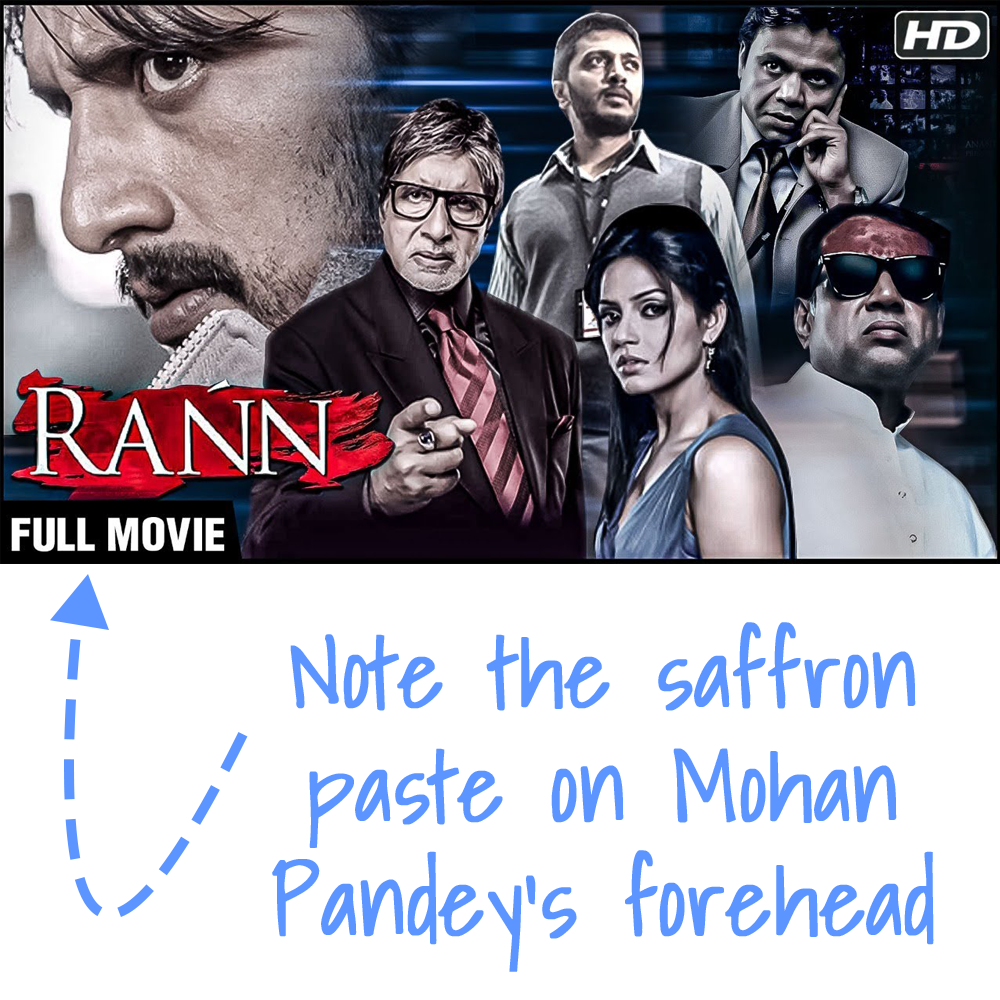
The opposition leader Mohan Pandey portrayed by Paresh Rawal is a textbook case of how politics uses communication. The Machiavellian approach with his negative grandiloquence and threatening the reigning PM’s righthand man to orchestrate the blame of the terror attacks in Muzaffarabad is unashamedly obvious. He has iconography on his forehead with the color saffron smeared garishly. His response to being asked what his first act as PM would be is “bathe in the Ganges” securing the ritualistic approach. He even holds his oath-taking ceremony at the site of the latest bomb blast which he orchestrated as a gesture of the competence of his “new regime”. His confirmation of one of the leading industrialists in the country in favor of his older brother is a masterstroke in securing power as well as financial backing. Through sheer manipulation, he even manages to get the one person the country trusts completely, India 24×7’s Vijay Harshwardhan Malik, further assuring his legitimacy. Lastly, he is an expert in dramatization as his emotional speeches can capture the mind of a nation betrayed by its leaders, building on the Hindu-Muslim peace that he himself sought to break in order to seize power.
Conclusion
Selfishness of human actions forms the core of the movie. Every character is motivated by his beliefs and how the media can play with this perception is the main message. Amitabh Bachchan’s final monologue has been praised by critics and audiences alike for how authentically it rings even today. One shouldn’t sell his or her dharma for profit as the many news channels, politicians, and even common people have in the movie. However, Rann does seem a bit dated when viewed with a Gen Z lens where the internet and social media, not any one person or news agency, are playing with the sensitivities of the public. The various media theories do come into play very openly but political ideologies such as communism, socialism, or capitalism, are only visible through subtext, and even then, their presence in the movie is intelligent speculation at best.
One of the only direct interactions between the journalist Purab and the opposition leader Pandey summarizes my thoughts on the link the movie establishes between politics and media quite well. When asked about his “politics”, Pandey interjects quickly and asks Purab to use the phrase “service to the people” instead.
Presentation is indeed everything.
Resources
- Chesebro, J. W. (1974, February 28). Theoretical Approaches to Political Communication. 1974-Mar.
- “Rann is inspired 100% by real life, says RGV” by Meera Iyer, published in TNN, January 21, 2010.
 Gauravaaditya